Not for profit · Magherafelt
Football, rugby and dance, before it counts.
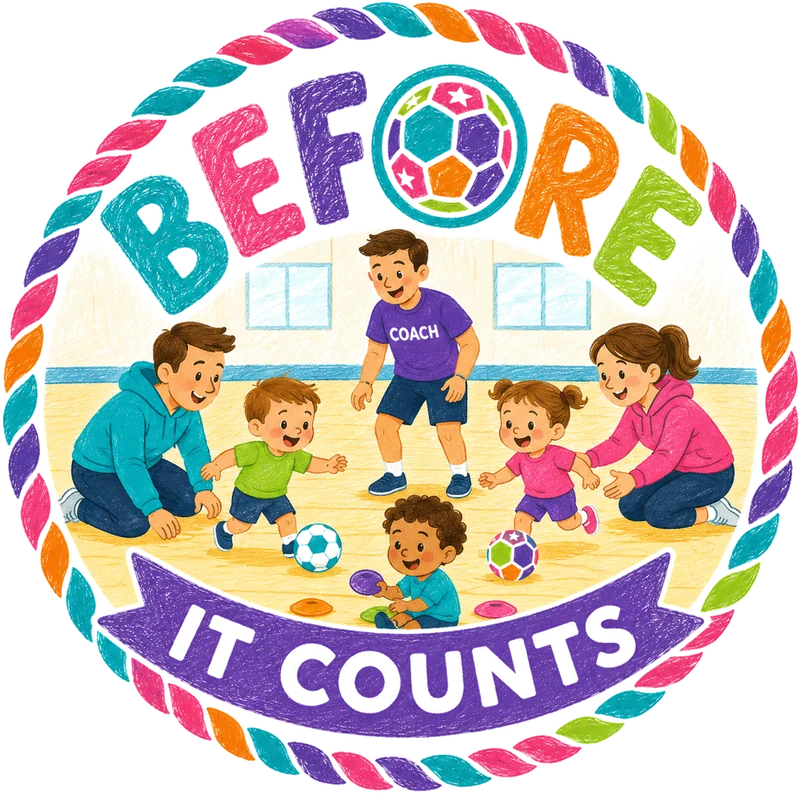
For one to five year olds in Magherafelt. An hour every Sunday, three sports inside it, the same faces every week and you on the floor beside them. Let them show you.
- When
- Sundays at 12, from January 2027
- Where
- Indoors, Magherafelt
- Ages
- One to five, in groups by age
- Cost
- £29 a month
Where things are
The second town, and the first with three sports.
Before It Counts started in Jordanstown in September 2026 as a football programme: 26 children, 25 families, full in six days. Magherafelt is where it goes next, and it goes with three sports instead of one.
The first Magherafelt group starts in January 2027. Put your name down and you hear the date, and the venue, before anyone else. Join the waiting list
Why three sports
Most children get their parents' sport, and never try another
A child ends up at football because their dad played football, or at dance because their mum danced. Nobody chooses it, least of all the child. And most of the parents signing a two year old up for anything are not signing up for a sport at all. They want their child moving, happy and around other children. The sport is incidental.
So instead of guessing, we let them try. Three sports in the same hour, every week, from the age when nothing counts for anything. By the time a club wants a decision, your child has already shown you.
Why it works
The world's sports doctors agree on this one. The International Olympic Committee's consensus on how young athletes develop says children should not specialise in one sport early: trying several builds better movement, cuts injury risk, and raises the chance a child finds the sport they will enjoy most. We are not building athletes. But the thing that makes a better fifteen year old makes a happier three year old too: variety, play, and no pressure to pick.
What we do about it
Four things, and everything else follows from them
They arrive together, not alone
A group joins together and stays together until they are five, then moves on to a local club as a group, in whichever sport won them over. Most of them will end up in the same nursery and the same P1 classroom. Friends from before nursery.
Three sports, every single Sunday
Three stations, three sports, about ten minutes each, and every child does all three every week. Nobody spends an hour on a sport they do not like, and nobody has to pick before they have tried.
You are in it too, and not on your own
On the floor, beside your own child. Nobody here is going to tell you how to handle them, but a hall full of toddlers being toddlers, with two dozen other parents working it out beside you, teaches you fast that refusing, crying and wandering off is just what two year olds do.
Nobody is keeping score
No sides, no trials, nothing to be picked for and nothing to be dropped from. An hour of messing about with people you like, in three different ways, where messing about is the whole point.
Local clubs take children from about four. We cover the years before that, and when the time comes we introduce friends to the club they loved, together. Which sport that is will be obvious by then, to you and to them.
The three sports
What a two year old actually does at each station
Nothing is explained, everything is shown once, and every game is a story a child this age can repeat in the car home. Here is what each sport looks like when the players are two.
Football
The one most of us know. At two it is kicking, chasing and rolling a ball that is too big for you, and finding out that it comes back.
- Kick a ball at something that falls over
- Chase it, catch it, carry it
- Score, in a goal that cannot be missed
Rugby
No tackling, no contact, nothing anyone could get hurt doing. At this age rugby is being allowed to pick the ball up and run with it, which is a revelation to a two year old who has just been told not to use their hands.
- Carry an oval ball that will not roll straight
- Run with it, pass it, hug it
- Fall over on purpose, onto something soft
Dance
The only station without a ball. Music, stopping and starting, copying a grown up, standing on one leg. Everything the other two stations ask for, learned a different way.
- Move when the music plays, freeze when it stops
- Copy, balance, spin, jump
- Make a shape and hold it
Guest sports
Once a block, one station hands over for the day to a guest sport that a local club comes in to show us: Gaelic, hockey, basketball, whatever someone will bring. Same hour, same rules, one more thing tried.
The hour
What actually happens
About forty five minutes, because toddlers are done at around forty. It runs the same way every week, because two year olds like knowing what comes next, and four rules run all of it: nobody queues, nothing gets harder, nothing can be done wrong, and every game is a story.
-
12.00
Straight onto the floor
In through the door, someone walks you to the hall, and your child goes straight out to play. Come to the desk whenever it suits: name ticked off, and two stickers in your group's colour for your child's top, one on the front and one on the back, so everyone can see at a glance where you start.
-
12.10
The first sport
No talk at the start. Your group's young helper walks you to your first station, the coach there runs the game, and your whole job is three words: stay close, praise trying, take breaks.
-
12.22
A drink, a story, the second sport
A drink from the bottle you brought, a short story read at the station, and across to the next sport.
-
12.37
A drink, bubbles, the third sport
Another drink, bubbles on the walk across, and the last sport of the day. The youngest fade around now, which is what the bubbles are for.
-
12.50
Three stamps, then bubbles
The passport: a stamp for each sport, pressed in by your child, and one line you pick for something they did today. Then bubbles, and a fist bump from the coach for every child. Leave whenever you are ready, and everyone is away by one.
The quiet corner
A corner away from the music, with a few small chairs, every single week. Any child who has had enough goes there with you and comes back when they are ready. Nobody is sent there and nobody minds.
Before you ask
The questions everybody asks first
Is one or two too young for rugby?
At one or two nobody is learning rugby, or football, or dance. They are learning that a hall, a coach and a room full of other children are safe, with you beside them. Rugby at this age is carrying a ball you are allowed to hold and falling onto a soft mat with it. There is no contact between children, and there will not be.
My son will not want to dance. My daughter will not want to play rugby.
Maybe. Everybody tries everything, for about ten minutes, with you beside them, and nobody is made to. What we see, and what you will see, is that at two the sport has no label yet. A boy copying a dance is working on exactly the balance a footballer needs, and a girl running with a rugby ball is doing what every child does with a ball they are allowed to carry. The labels come later. This is the bit before them.
Do we have to say which sport we are interested in?
No. That is the point. If you already knew, you would be at a club.
What if they will not join in, or they cry?
We are expecting it. A child who will not join in is the reason this exists. At five, in front of a coach with forty children, it can cost a place. At two, on your knee, it costs nothing. Watching is taking part. There is no drop off, so there is no handover to be upset about, and the quiet corner is there every week. Some children sit out for weeks and then one Sunday they do not, and by the time it matters, joining in is just what they do.
Who runs it?
Volunteers, as in Jordanstown. A coach for each sport, with young helpers walking the groups round. Every adult coaching on a station holds an enhanced AccessNI check before the first Sunday, and you are in the room the whole time. Nobody running it is paid.
Are we committing to years of this?
No. Staying together is what is being built, not what you are being asked for. You pay monthly and you can stop whenever you like.
Where the three sports idea comes from: International Olympic Committee, Consensus statement on youth athletic development, British Journal of Sports Medicine, 2015. The rest of the reading behind the programme is on the idea.
Not a franchise
Want this in your town?
Before It Counts is free to anyone who wants to run it where they live, in any sport. Email and we will send you everything we have: the hour, the games, the forms, the costs, and what we got wrong.
First group: January 2027
If this sounds like your Sunday, put your name down and you will hear the date, and the venue, first.